Decay
April 4th – 25
Opening Reception April 4th, 3-5 pm
Guest curated by Izzy Dunn, UW Museology

Featured in Seattle Magazine, Spring Arts
Decay explores how we navigate and engage with the inevitable entropy of our world.
This exhibition shows us the joy of degeneration, the beauty of collapse, the peace that comes from crumbling into dust. The work, primarily from Pacific Northwest artists, ranges from sculptural to to wall-mounted, from video to installation. Many pieces incorporate natural and reclaimed materials, as well as pieces designed to create spaces for quiet reflection on the theme. Decay appears as part of the natural world and in our bodies in many forms, and so over the duration of the show, some works may change over time, exemplifying the theme. Many of the projects prompt reflection on mortality, the fragility of the physical body and the sacred.
The exhibition represents the Master’s thesis of Izzy Dunn, in the UW Museology department. Dunn’s curatorial foci are mid-century and contemporary abstract art, and she is especially interested in new takes on thematic elements and materials. For this show, Dunn and the gallery offered an open call to lower barriers to access to exhibition by emerging artists.
Artists’ Statements and Bios
-
Basma Saleh is an Egyptian visual artist and Assistant Professor whose work explores the evolving relationship between the organic and the digital. Her background in printmaking, media arts, and interdisciplinary research informs a practice that investigates fragmentation, instability, and the shifting thresholds between structure and coherence. She has published in peer-reviewed journals, presented at international conferences, and earned national awards.
Her research and artistic practice engage posthumanism, AI-driven sensorial systems, and technologically mediated forms of embodiment. Current projects examine identity formation within AI-enhanced immersive environments, integrating sensing technologies, generative systems, and reflective spatial design. She continues to develop interdisciplinary work that connects artistic innovation, academic rigor, and cross-cultural exchange. She has exhibited widely across Egypt and the Middle East and is currently a Fulbright Visiting Scholar at the Rhode Island School of Design, where she expands her research into hybrid sculptural forms, immersive installation, and contemporary digital art.
My practice investigates the shifting boundaries between the organic and the digital, tracing how bodies, systems, and identities transform under pressure. I work with hybrid materials and layered processes to explore fragmentation, instability, and the quiet thresholds where structure begins to loosen. Across sculpture, installation, and new media, I am drawn to moments when forms slip out of coherence and reconfigure themselves into something newly alive.
Digital Selfhood extends this inquiry by approaching decay as a generative state. The sculpture merges 3D printed geometries with tensioned copper wire, creating a form that hovers between breakdown and emerging coherence. Its hollow mirrored core fractures the viewer’s reflection into shifting fragments, echoing the instability of contemporary selfhood. A touch responsive sound layer deepens this sense of living decay, allowing the work to subtly transform through interaction, positioning decay as a force that reshapes identity through unraveling and continual reformation.
-
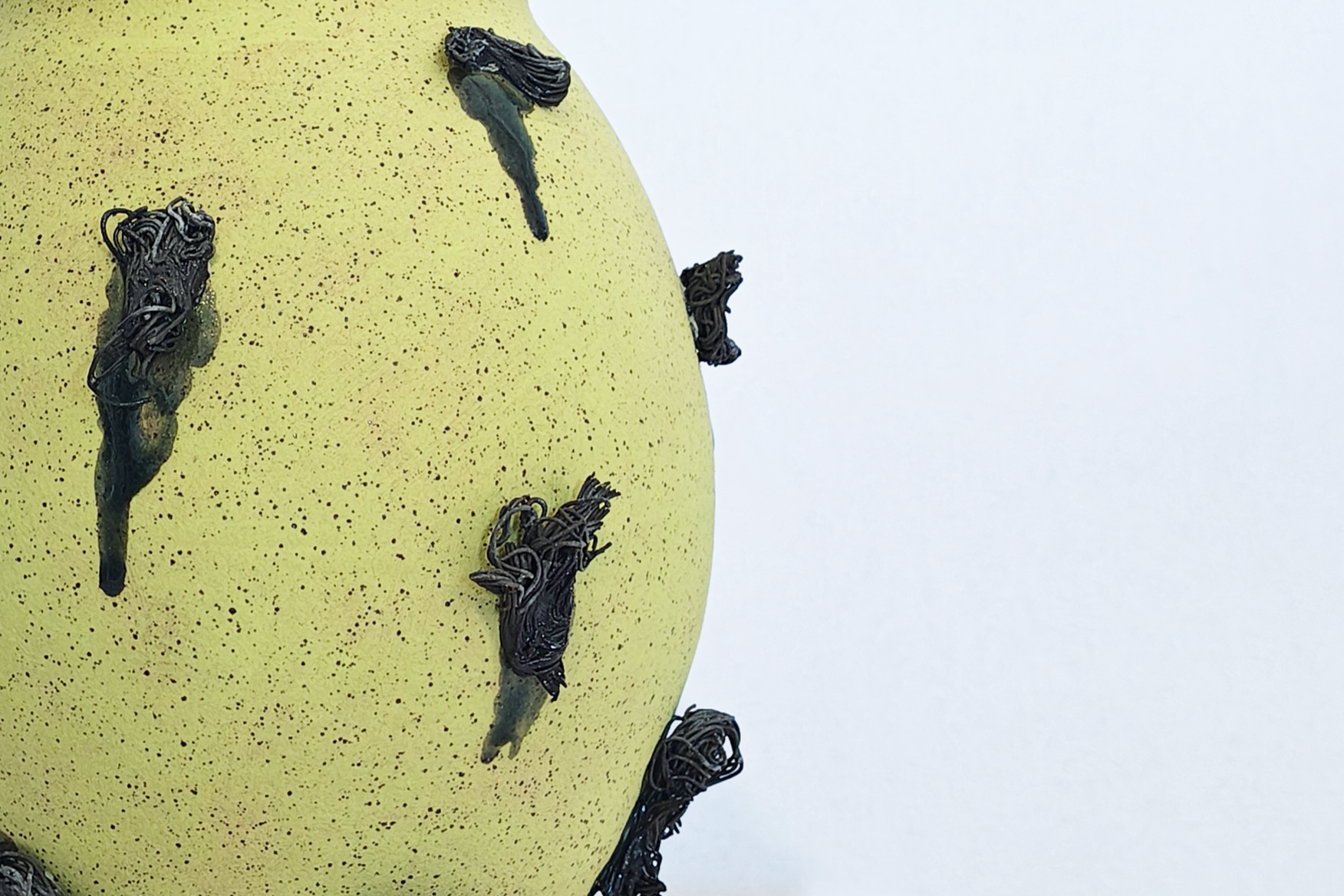
Coco Spadoni is a Seattle-based artist working in painting and ceramics. Their work draws inspiration from ritual, dreamlike states, biomorphic forms, and queer theory. Spadoni holds a B.A. in Community Art from Western Washington University. They have exhibited throughout the Pacific Northwest and nationally, including at Antler Gallery, Base Camp Studios, Pottery Northwest, Gallery One, and the Houston Center for Contemporary Craft. Their work has also appeared in public art projects in Downtown Seattle. Spadoni has participated in residencies at Rockland Woods (Kitsap, WA) and the James Black Gallery (Vancouver, BC), and is a 2024 Artist Trust GAP recipient.
Spadoni’s work draws inspiration from ritual, dream states, biomorphic forms, and queer theory. Working across painting and ceramics, they create environments that invite viewers into alternate worlds or intimate scenes where the boundaries between “place” and “living being” dissolve. They are interested in how feelings can manifest physically, and how forms can embody human experience. Their work often provides a space for reflection on curiosity, intimacy, and the emotional life, allowing emotions to take on their own narrative or presence. For the piece featured in this show, Spadoni examines decay as a generative process, exploring the fluid interplay between an original emotion and the living forces it can become.
-
Jay Stoneking is a queer artist and author. His works explore the boundary between art and the occult, drawing inspiration from fantasy and science fiction alongside symbols and forms from modern witchcraft.
Stoneking's creative practice includes traditional and digital mediums, installation, game design, and written works. His art has been shown at galleries throughout the Pacific Northwest and his paintings can be found in private collections across the United States and Canada. His graphic novel, The Unbound Arcana, is an ongoing fantasy series.
Flowers, leaves, bark, and moss are collected, dried, then arranged into patterns and color fields. Days turn to nights into months into years. Colors fade, people die, phases of life pass — what remains from these moments become fragile physical memories of things that once were.
-
My work uses repetition, found materials, and tactile surfaces to explore themes of growth, suffering, and transformation. I make object based work spanning sculpture and craft using a visual language of softness and precision. I mostly work with gleaned materials in mediums such as clay and fiber.
The fig tree and fig wasp share a mutualistic relationship, relying on each other for reproduction. In order to lay her eggs, the female fig wasp forces her way into an unripe fig, tearing off her wings and antenna in the process. She dies inside the fig and is eventually absorbed by the fruit’s enzymes. The pollinated tree can then produce ripe figs for the continuation of its life cycle.
Each fig was individually sculpted as part of a personal meditation on wasted sacrifice.
Jess Cheng is an interdisciplinary artist working in clay, fiber, and installation. They immigrated to the US at three years old and grew up in rural Arkansas as the sole person of Asian descent in their class. After discovering clay while studying Mechanical Engineering in 2014, Jess has exhibited at Arrowmont, Watershed, and Mendocino Art Center. They've assisted workshops at Penland School of Craft and Archie Bray Foundation, taught at Saltstone and Pottery Northwest, and established their own teaching business in 2023. Their sculptural practice incorporates clay and natural materials, particularly invasive species, exploring themes of nurture, suffering, and transformation. Jess currently teaches at Reclaim Clay Collective in Seattle.
-
John Schmitz creates and documents transient installations of found materials in the intertidal zone, that dynamic space where land and sea meet between low and high tide. The installations serve as opportunities for contemplation, learning, and ideally to spur action to address the impacts of the climate crisis in our region.
SALISH RELIQUARY documents the creation and subsequent dismantling of a saltwater "reliquary" installation on February 28, 2026 on the shores of Skagit Bay during a flood tide. It is composed of organic and humanmade objects in various states of decay that tidal currents routinely leave on this beach: concrete blocks, driftwood, seaglass, crab carapaces, bull kelp, bones, shells, reeds, and ground pigment from the ubiquitous terracotta shards. In this context, these mundane items are briefly elevated as relics, inviting our attention to both honor their contributions and question their presence.
-
My work reflects my close, year-round observation of unsung native vistas. While committing to scientific accuracy in depicting living things, as an artist I also see metaphor, beauty, and complexity of design among nature’s patterns. Through my eyes, the luxurious mingling of growth and decay in intertidal waters, on the forest floor, and on old trees lends itself to abstract compositions and patterns. Aging, death, and decay provide essential resources of nutrition and shelter to ecosystem members, and enrich the soil for the next generation. Valuing the end stages of life helps us unlearn society’s youth-centric and fertility-centric concepts of beauty. As an older artist, such a reframing is affirming and generative. Distressingly, though nature is our collective home, human activity has caused irreparable losses of habitat, resources, and species. So, by revering our humble local biota, I aim to respond to ecologists’ call for ecosystem restoration and to remind viewers that each of us can contribute to rewilding.
Julie Baer has been painting for over 40 years. As a teenager struggling with undiagnosed PTSD, artmaking was lifesaving for her, providing a calling, a practice, a generativity. She attended Rhode Island School of Design out of high school. While raising her sons, she made art, exhibited full-time, and published two picture books. In 2007, she returned to school for education, earning a master’s in 2009 (Harvard Graduate School of Education) and doctorate in 2018 (Northeastern University). Until 2022,she taught writing to students of all ages and backgrounds, from incumbent workers at Boston hospitals to nursing students at UMass Boston to first-year college students. The pandemic brought her back to the studio full-time, transformed. In 2024 she served as Visiting Artist at the Native Plant Trust in Massachusetts. She recently moved from Boston to Bellingham, WA.
-
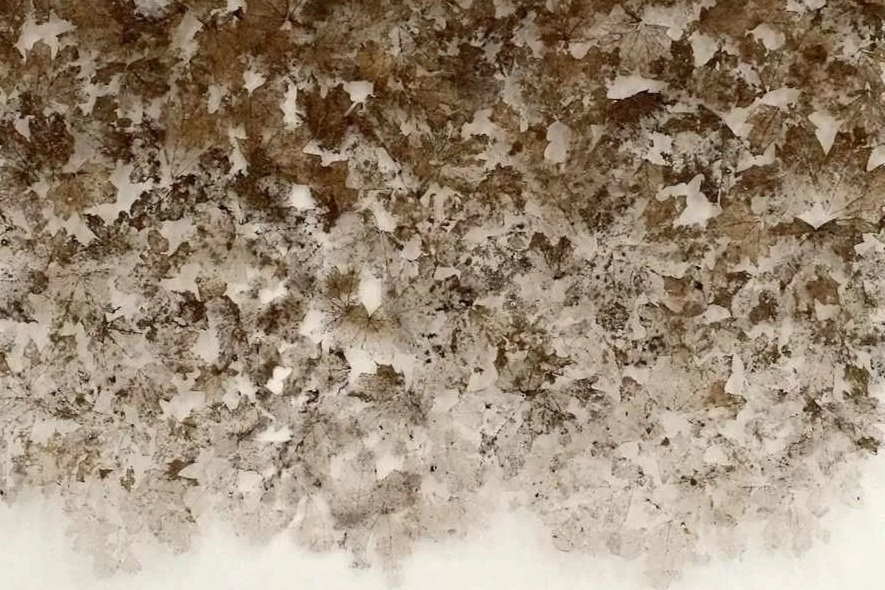
In Leaf Lace, maple leaf skeletons gradually shift from solid to skeletal, exploring the role insects play in the process of decomposition as they continue the cycle of life and expose the delicate, lacy inner structure of leaves. Decomposition is a crucial part of the seasons, returning nutrients to the soil for spring while providing shelter and food for the understory. It is a recycling process that disposes of the old to make way for the new. This rebirth occurs physically in the earth but metaphorically within ourselves. Decay is the process through which transformation happens. For us, new information and experiences break down preconceived notions and ideas, allowing space for fuller, more nuanced convictions. Decay is nature’s gentle reminder that impermanence, change, and even loss are simply the next stage of existence, that everything and everyone cycles through a return to essential elements.
Julie Anne Mann’s early life was shaped by the landscapes of the Pacific Northwest where she was raised on the Olympic Peninsula in Washington State,. The region’s towering forests, stormy coastlines, and complex relationship with natural resource industries left a lasting impression. Education, recreation, and the local economy were inextricably tied to the land, fostering a lifelong sensitivity to the ways humans shape and are shaped by their environments. After relocating to New York to study at the School of Visual Arts in Manhattan (2001), her work garnered recognition through several grants and awards, affirming her commitment to a practice that is materially grounded and conceptually definitive. Returning recently to the Pacific Northwest, she continues to explore the intricate relationships between people, materials, and place, drawing from past and present experiences at her studio near the mountains and the sea.
-
Meghan Thréinfhir (née Meghan Elizabeth Trainor) is a Seattle-based artist, writer, lecturer, performer, and curator. Her work has been exhibited nationally and internationally from Seattle and New York to Copenhagen and Barcelona. Recent solo exhibitions include Bog Memory / Computer Memory at Captive Portal in Copenhagen, curated by Kristoffer Ørum, and Let Us Not Confuse Zero With The Stillness Of Electrons at Center On Contemporary Art (COCA), curated by Negarra A. Kudumu. Her video and generative code-based work was recently included in X Æther at Captive Portal in Copenhagen.
In the early 2000s Thréinfhir produced groundbreaking work in networked and distributed media systems, particularly through artistic uses of RFID and ubiquitous computing. Her RFID-based performances and installations were written about in venues such as Wired, Mute, and We Make Money Not Art, positioning her among an early generation of artists exploring distributed computing and embedded network technologies as artistic media. Her RFID-cyborg performances as Megatron were featured in Ask The Robot, a performance series she co-produced at The Frying Pan in New York City.
-
Photography has a habit of degrading a memory and overwriting it in its own image. By contrast, vivid experiences gave new context and shape to this collection of failed photos of nothing. On their own, the individual polaroids capture abstract shapes of decaying film chemistry. But an immersive, encircling mountain range in Oregon re-contextualized the uneven flows of
developer into its endless rolling mountain scapes. And the experience of minimal light-allotments over Northern Washington winters gave meaning to the unexpected bursts of light in the diminishing color dye smears. Photos, with their impermanent and fallible materials, are typically used to frame a scene and preserve it from time and change. The new arrangements of these polaroids capture an experience of a landscape reshaping deteriorating photos into a larger, lived moment.
Nif is a visual artist who uses the tactile, mutable, and 'chance' qualities of different mediums to explore the ephemeral and subjective space where place and perception meet. Born in Washington, D.C. and currently living in Washington state, Nif has lived more than a dozen places in between. She received an MFA from San Francisco State University, and is the recipient of awards, including The Bryan Robertson Trust Award (UK) and the Murphy, Cadogan, & Phelan Fellowship (CA). She has held residencies at Praxis Fiber Arts (Cleveland), PLAYA Art & Science (Oregon), Skylight Studio (Los Angeles), and Kala Art Institute (Berkeley). Her work is in public and private collections, and has been exhibited nationally and internationally. Her artist books
and collaborations are published under the imprint ‘subtext press,’ and explore what may be overlooked in the relationships between time, movement, memory and place.
-
Fungi are fundamental agents in decay – nature's premier decomposers. During COVID lockdown, I began to make spore prints from hundreds of mushrooms foraged from local mountains, golf courses, the University of Washington campus, Seattle city parks and my backyard.
A spore print is made by removing a mushroom stem and placing the cap down on a substrate of paper or glass. Over time and in collaboration with air currents in my studio, spores fall, producing a fine powder that varies in color and character. Witnessing the spores drop is magical; it’s as if the mushrooms are drawing themselves on the glass or paper I provide. Paradoxically, the images formed by the spores resemble photographic negatives; they also conjure spectral or cosmic associations.
The piles of spores are 3-dimensional, fragile, and easily disturbed. Here, the white spores on black paper are documented photographically for presentation.
Rebecca Cummins explores the possibilities of light and natural phenomena, often referencing the history of science and optics. She has exhibited widely and is active in public commissions and cross-disciplinary collaborations.
Exhibitions include Experimental Encounters, Beal Center for Arts + Technology, University of California, Irvine, CA (2025); Gallery 4Culture, Seattle (2023); Still.Moving, Bellevue Art Museum Biennial: Architecture & Urban Design (2021); Lux’Aeterna, Art Center Nabi @ Asia Culture Center, ISEA, Gwangju, South Korea (2019); Reticula, Concepción Arte y Ciencia Biennial, Chile (2019); Biennial of Seville, Spain (2008); Zendai Museum of Modern Art, Shanghai (2008); Quay Art Gallery, Images Festival, Toronto (2006); 6th Shanghai Biennial, Shanghai Museum (2006); The Museum of Contemporary Art KIASMA, ISEA, Helsinki (2004); South Australia Biennale of Australian Art, Adelaide (2002); and the traveling exhibition ILLUSION: Science Gallery, Trinity College, Dublin, Ireland (2013-18). Public commissions have been completed for the City of Seattle Office of Arts & Culture, the Washington State Arts Commission and the Exploratorium, San Francisco.
-
My practice as a fiber artist is rooted in materiality and process. I work at the intersection of handcraft, archaeology, and technology creating textiles that serve as meditations on fragmentation, repetition, semiotics and impermanence. These themes emerge through an ongoing inquiry into broken narratives, syncretic belief structures, ancient glyphs and patterns of entropy.
Influenced by the language and reflexive archaeology, I explore the body as both archive and artifact. My Half-membered Marks series examines the human form as a site of excavation, drawing from concepts like midden, relic, and ancient text(ile). Each work is constructed from raw wool and ungalvanized steel, materials that are felted, stitched with steel wire, and rust dyed. The wool contracts through felting, and the embedded steel rusts, dyeing the fibers naturally while accelerating decay. These transformations, visceral and inevitable, are part of the work's core meaning.
R. Mertensis an artist whose practice examines materiality, identity, and technology through textiles, sound, and performance. He holds an M.F.A. from the University of Oregon, a B.F.A. from the School of the Art Institute of Chicago, and an audio engineering certificate from NWTC. Additionally, he has studied at the Burren College of Art (Art and Ecology in Ireland), the Apulaya Center for Andean Culture (Weaving and Religion in Peru).
Mertens’ work has been exhibited internationally and nationally, Hangaram Museum of Design (Seoul), and the Bellevue Art Museum (WA) among others. He has received a Virginia Museum of Fine Arts Professional Artist Fellowship Award, the Trawick Award (2nd place) and has been an artist in residence at Cill Rialaig Projects and Atelier Westcove in Co. Kerry Ireland.
He is Associate Professor of Art at James Madison University, head of the Fiber Arts area and directs study abroad programs to Ireland.
-
Whalefall examines the transformation of life after death. After a whale's last breath, the body descends to the ocean floor and serves as habitat for hundreds of species over decades. The organic and digital elements of the installation emulate the slow unfolding of entropy after a death, progressively dispersing and reorganizing into new living systems. The organic material atop the skeleton is the cellulose byproduct of a symbiotic culture of bacteria and yeast. The new life generated from this flesh is rendered as an emergent system where digital organisms arise, grow, and interact with each other in a real-time simulation.
The work lingers in the slow labor of decay: mouths and microbes stripping flesh from bone, releasing energy incrementally as nourishment that radiates outward into a living, proliferating network.
Sabin Timalsena and Anna Czoski have collaborated on interactive installations using themes, processes, and materials of nature since their involvement in a large public artwork with Future Arts in 2023. Sabin is a Nepali algorithmic artist who uses principles from mathematics, computer science, and systems in nature to create digital art, animations and interactive experiences. Anna is fascinated by systems and phenomena in the natural world and creates work in multiple forms from mixed reality experiences to bioArt installations.
-
Place is where you know the scent of the sidewalk grit after a rain. The longer I live in a place the more I notice the extraordinary in the everyday. Surreal visions amid stable surroundings feel like home to me. I want to experience the seasons (and their more subtle transitions), feel the particular elements of climate, understand the ecological behavior over time. As I walk around my neighborhood and city, I’m able to explore these things at a slower pace. Occasionally, I glean an interesting scrap material that I bring back to the studio. The ground is my oyster, loam-filled. Under the ground, a psychic place for me, is the world unseen, holding mystery and mythology where invisible life—real and imagined—persists. The feeling of security and warmth resides here. In this way, both the physical and imaginative aspects of place serve the work I create. I make drawings and sculpture. I’m interested how the two concentrations enhance one another and at times, overlap. My work is process-driven where my intuitive and conceptual modes of working intertwine. I use carving stone, terracotta clay, graphite, used sandpaper, bells, kukui nuts, wool felt and collected fragments. I give tender attention to discarded material which I redignify. The completed work often results in a form hinting at an ongoing ritual.
After Game (Hive) originates from an abandoned, beat-up soccer ball I found in a Seattle park. After cutting open the ball, its interior revealed a deflated air bladder inside. For me, the outer form referenced a head, the air bladder an intellect. I like to imagine when our physical and intellectual faculties no longer exist, a lively spirit realm is ready to respond, a part of ourselves that hasn’t fully manifested. A coterie of amulets (kukui nuts, bells, alabaster rabbit, gold figure) occupy the hivelike interior, containing aspects of protection and safe transition beyond terrestrial existence.
Sara Oseboldis a visual artist who works in sculpture and drawing. She references themes based on the underground, the phenomena of natural and urban environments and the extraordinary found in the mundane. She received her BFA from University of Washington in printmaking and MFA from Pratt Institute (NY) in sculpture. She is a past member of Seattle’s SOIL art collective. She completed a gallery residency with the Seattle Office of Arts and Culture. Her works reside in private collections in the US and Europe. She has exhibited nationally and internationally in New York, Boston, Portland, California, Connecticut, Japan, The Netherlands and various art venues in Seattle and Washington. She continues her childhood pursuit of collecting rocks with exceptional textures.
-
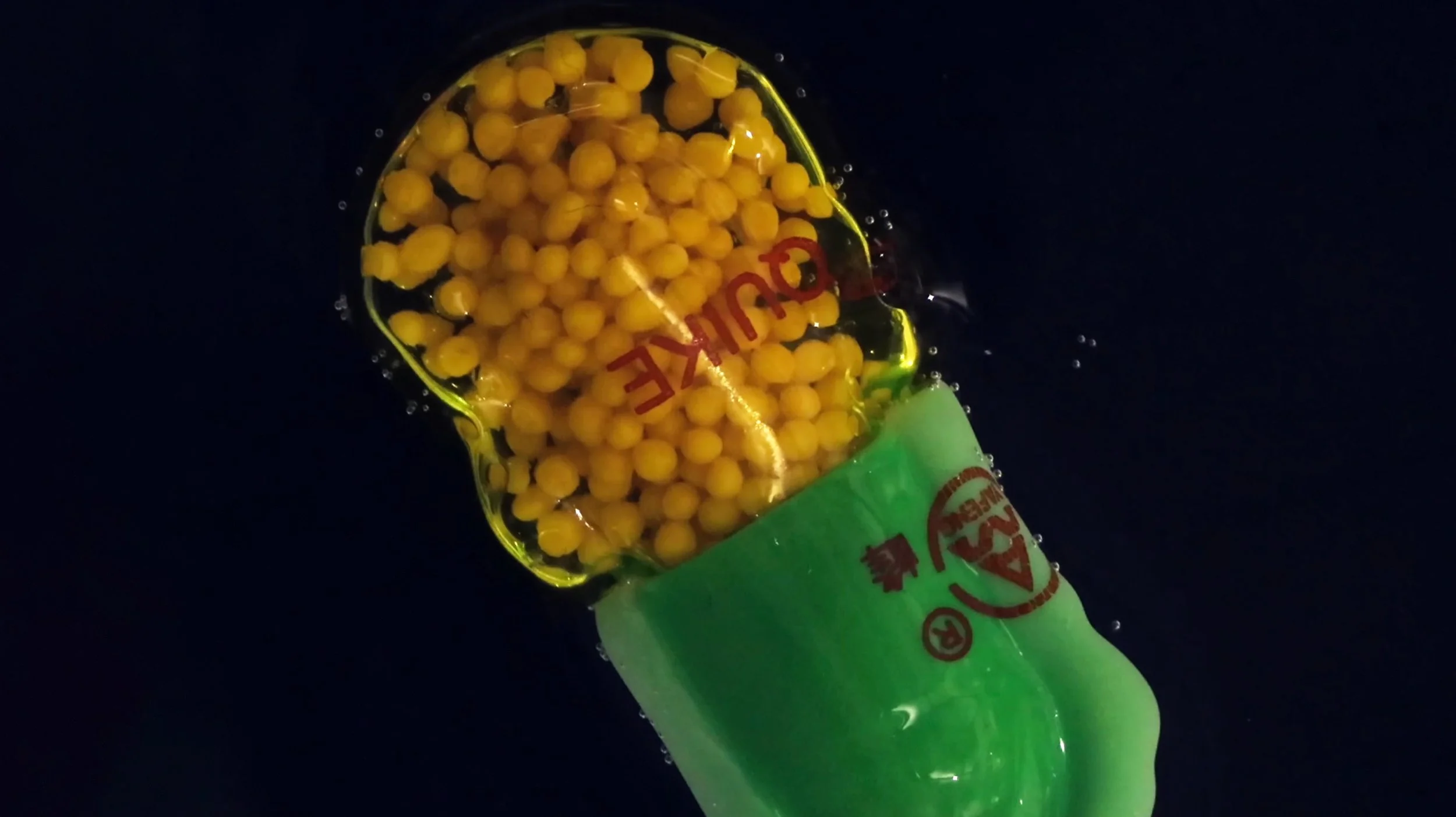
In Solutio, decay is not diminishment but activation—the pill’s effectiveness depends on its programmed disappearance. The work focuses on pharmaceutical pills dissolving in an acidic liquid resembling stomach acid, slowly shedding their edges, color, and structure until they disperse. This decay is the mechanism: the pill must break down to “work.” Yet the knowledge of that breakdown is unevenly held—perspicuous to designers, chemists, and manufacturers, while opaque to most of us who ingest it. Dissolution becomes a study of how decay converts certainty into effect: what begins as a discrete, nameable object becomes an invisible chemistry moving through the body.
Presented as a looping video installation, the piece makes dissolution visible over time, as form recedes rather than accumulates. Solutio treats entropy as both care and control, foregrounding how benevolent research is entangled with profit-driven infrastructures that deliver healing through designed disappearance.
Yuhanxiao (Maggie) Mais a U.S.-based, research-driven multimedia artist and PhD researcher in the Center for Digital Arts and Experimental Media (DXARTS) at the University of Washington. Working at the intersection of speculative fiction, science, and ethics, she investigates how technological systems shape lived experience and reveal the often-overlooked consequences of innovation. Across 3D fabrication, physical computing, and multimedia installation, Ma adopts the visual and procedural languages of science—clinical displays, reports, and imaging—to examine trust, vulnerability, and the politics of evidence. Her methodology reconstructs authoritative formats, then introduces subtle ruptures that make their logics perceptible. Often centering pharmaceuticals as both material and metaphor, her installations invite viewers to question how “truth” is verified, circulated, and believed. Her work has been shown internationally, including at Ars Electronica (Linz), and exhibited in New York, Barcelona, and Shanghai.